

HVAC static pressure is the pressure within a heating and cooling system that indicates the resistance the blower encounters while moving air through ducts, filters, coils, and air registers. When static pressure is too high, the system may struggle to deliver enough conditioned air, resulting in weak airflow, excessive noise, uneven temperatures, and reduced equipment performance. Properly designed Custom HVAC ductwork can help address airflow restrictions by matching duct dimensions and layouts to the system's heating and cooling requirements.
Every central HVAC system uses a blower to circulate air. Return ducts carry indoor air toward the equipment, and supply ducts distribute heated or cooled air throughout the home. As air moves through these passages, it encounters resistance from duct walls, elbows, filters, cooling coils, and registers. Some resistance is normal and is accounted for during equipment selection and duct design.
Problems develop when the installed system places more resistance on the blower than its design allows. Understanding static pressure helps homeowners recognize why a system can run continuously yet fail to provide adequate comfort.
What Is Static Pressure in an HVAC System?
Static pressure describes the pressure exerted by air within the duct system. In HVAC diagnostics, technicians use pressure readings to assess resistance along the airflow pathway. The return side of a typical forced-air system operates at negative pressure relative to its surroundings because the blower pulls air toward the equipment.
The supply side operates at positive pressure because the blower pushes air toward the rooms. Air Conditioning Contractors of America (ACCA) identifies static pressure measurements as an important part of checking installed HVAC performance.
What Is Total External Static Pressure?
Total external static pressure, commonly abbreviated TESP, represents the combined pressure difference across the external components associated with an air-moving unit. Technicians generally obtain appropriately positioned supply-side and return-side readings and combine their magnitudes.
The exact measurement locations depend on the equipment configuration and which components the manufacturer includes in its rating. TESP is usually measured in inches of water column, written as in. w.c. or in. wg. A technician compares the measured value with the manufacturer's published blower performance information.
What Is Normal HVAC Static Pressure?
Many conventional residential furnaces are rated around 0.50 inches of water column for total external static pressure. However, 0.50 is not a universal limit for every HVAC system. Some air handlers and other equipment have different pressure ratings.
| Static Pressure Concept | What It Means |
|---|---|
| Return-side pressure | Pressure where air enters the equipment |
| Supply-side pressure | Pressure where air leaves the equipment |
| Total external static pressure | Combined pressure difference across the rated external system |
| Manufacturer's pressure rating | The reference used to evaluate operation |
| Component pressure drop | Resistance across a filter, coil, or other component |
The correct reading must be evaluated against the specific equipment's blower table and installation requirements.
Why Does HVAC Static Pressure Matter?
Static pressure influences the volume of air the blower can deliver.
When resistance is excessive, some blowers deliver less airflow. Certain variable-speed blowers attempt to compensate by increasing their output, which can increase electricity use and noise. A professional hvac inspection service can measure static pressure, check airflow restrictions, and identify system issues that may be affecting performance and energy use.
ACCA recommends measuring static pressure to identify restrictions and verify whether installed systems operate within their intended conditions. High resistance can also affect the performance of heating and cooling components.
What Causes High HVAC Static Pressure?
Several conditions can increase resistance within the system.
- A dirty or heavily loaded air filter.
- An undersized return duct.
- Restrictive supply ductwork.
- Crushed or sharply bent flexible ducts.
- Closed or obstructed registers.
- Incorrectly positioned balancing dampers.
- A dirty evaporator coil.
- Inappropriately selected filter media.
- Restrictive decorative grilles.
- An improperly matched blower and duct system.
More than one restriction may be present.
For example, an undersized return combined with a heavily loaded filter can create greater resistance than either problem alone.
What Are the Signs of High Static Pressure?
Homeowners cannot determine static pressure accurately from sound or airflow alone, but several symptoms suggest testing may be worthwhile.
| Warning Sign | Possible Connection |
|---|---|
| Weak airflow | Blower may struggle against excessive resistance |
| Loud return vent | Restrictive return pathway |
| Whistling supply registers | High air velocity or restrictive openings |
| Uneven temperatures | Inadequate airflow to certain rooms |
| Unusual blower noise | Blower operating under difficult conditions |
| Frozen cooling coil | Insufficient airflow may be contributing |
| Furnace limit shutdowns | Airflow may be inadequate for heat removal |
| High operating costs | Extended operation or increased blower effort |
These symptoms can also indicate other problems. Static pressure testing helps distinguish actual resistance from equipment faults.
Can High Static Pressure Damage an HVAC System?
Excessive resistance can contribute to equipment operating outside its intended airflow range. Low airflow across an air-conditioning evaporator coil can lead to cooling problems, including coil freezing under certain conditions. A furnace also needs sufficient airflow to carry heat away from the heat exchanger. Restricted airflow can contribute to high-temperature limit trips.
Some variable-speed blower motors increase their effort to maintain airflow against added resistance. The consequences depend on the equipment type and severity of the restriction. A qualified technician should evaluate the system rather than assuming damage has already occurred.
How Is HVAC Static Pressure Measured?
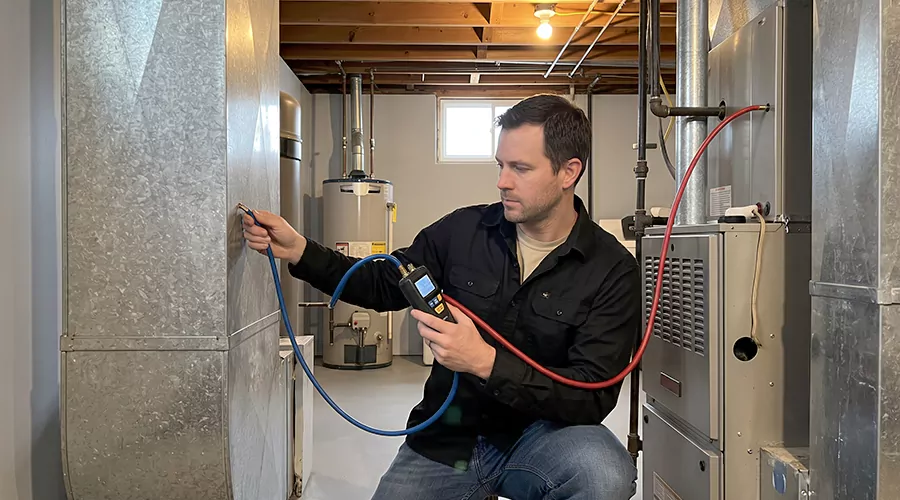
Professional technicians commonly use a digital manometer, pressure tubing, and appropriate static pressure probes.
Step 1. Review the Equipment Specifications
The technician identifies the blower model, rated external static pressure, and appropriate testing conditions.
Step 2. Establish the Required Operating Mode
The system is operated at a suitable airflow setting, often the cooling airflow setting for residential testing.
Step 3. Identify Measurement Locations
The contractor chooses supply and return test locations according to the equipment manufacturer's instructions.
Step 4. Record Pressure Readings
The manometer measures pressure on the appropriate sides of the equipment.
Step 5. Calculate Total External Static Pressure
The technician combines the applicable readings and compares the result with the equipment rating.
Step 6. Identify Restrictive Components
Additional measurements across filters, coils, and duct sections can help determine where excessive resistance occurs. Testing may require carefully positioned access ports. Homeowners should not drill into furnace or air-handler cabinets because electrical wiring, refrigerant lines, and other sensitive components may be present.
How Can You Reduce High HVAC Static Pressure?
The solution depends on the source of the restriction. Start with basic maintenance, including replacing dirty filters and clearing blocked registers. If testing identifies restrictive ductwork, repairs may involve improving return capacity, correcting crushed branches, or replacing undersized sections.
A dirty cooling coil may need professional cleaning. Incorrect damper settings may require measured airflow balancing. Avoid lowering blower speed or removing filters as a shortcut. Both actions can create new equipment problems.
Is Low Static Pressure Always Better?
No. Static pressure readings must be interpreted alongside delivered airflow and the equipment's operating requirements. An unusually low reading may result from inadequate blower operation, disconnected ductwork, or another condition.
A system with apparently low resistance is not necessarily delivering the airflow each room needs. The objective is appropriate airflow at acceptable pressure, not achieving the smallest possible reading.
How Often Should Static Pressure Be Checked?
Static pressure testing is useful during new HVAC installation, equipment replacement, major duct modifications, and troubleshooting. Homeowners may also request it when a system develops persistent airflow or noise problems.
A technician can establish baseline readings during a maintenance visit when appropriate. There is no universal requirement for every residential system to undergo static pressure testing annually.
Conclusion
HVAC static pressure helps technicians evaluate the resistance affecting air circulation through heating and cooling equipment. Excessive pressure can contribute to weak airflow, uneven temperatures, noise, and operating problems. Proper testing requires a manometer and comparison with the manufacturer's specifications. The best repair addresses the actual restriction, whether it involves filters, coils, ducts, or return-air capacity.